What Buyers Will Be Looking for in Homes in 2027
16 April 2026
Alright, future-homeowners and real estate fortune tellers, gather ‘round. Put down your virtual reality headsets and pause your robot butler’s charging cycle for a second. We’re about to gaze into the crystal ball—or more accurately, the very smart, voice-activated orb that also manages your investments—to see what the heck homebuyers will be lusting after in 2027.
Forget the open-concept living of the 2020s. That’s so… three years ago. The home of 2027 isn’t just a place to live; it’s a personal ecosystem, a wellness pod, a fortress of solitude (and Zoom calls), and maybe even a minor revenue stream. It’s less “HGTV Dream Home” and more “Tony Stark’s casual lake house, but sustainable.” Intrigued? You should be. Let’s dive into the future, one hilarious and probable prediction at a time.
The Great Indoors: Your Home as a Biophilic, Tech-Integrated Sanctuary
First things first: the pandemic taught us that our homes need to work for us, not just house us. By 2027, that lesson will have evolved from “need a home office” to “need my home to actively improve my mental, physical, and digital health.” It’s a tall order, but here’s how we’ll see it.The "Not-So-Home" Office: Disappearing Acts & Hologram Desks
The dedicated home office? Cute. In 2027, buyers will demand flexible, disappearing workspaces. We’re talking about Murphy desks that fold into art-covered walls, voice-command partitions that glide out of the ceiling to section off a corner of the living room, and furniture that morphs from a sofa to a professional video-conference backdrop at the clap of your hands (or the sigh of your exhaustion).But the real kicker? Holographic and augmented reality workspaces. Why have three bulky monitors when your entire wall can become a interactive display, or your coffee table can project a 3D model you’re working on? The “office” won’t be a room; it will be a mode your house can enter, like “Romantic Evening” or “Panic Cleaning Before Guests Arrive.” Buyers will be asking, “How many ‘Productivity Pods’ does this floor plan support?” and “Is the Wi-Fi strong enough to handle my holographic assistant’s existential crises?”
Biophilic Design: Bringing the Outside In (Literally, Not Just a Potted Ficus)
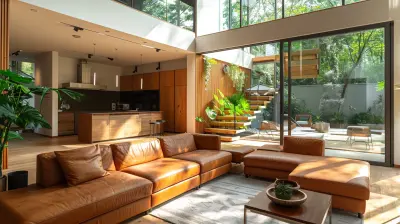
“Indoor-outdoor living” will get a serious upgrade. It won’t be about a nice patio anymore. Buyers in 2027 will seek fully integrated biophilic design. Think: living walls that are part of the home’s air filtration system, indoor water features that provide white noise and humidity control, and skylights that automatically tint to optimize circadian lighting.The goal? To make your home feel less like a box and more like a serene, organic cocoon. Materials will be key. Expect to see listings boast about “mycelium-based insulation,” “locally sourced reclaimed timber with embedded moss,” and “clay plaster walls that regulate humidity.” It’s about a connection to nature so seamless, you might find yourself apologizing to your kitchen island for chopping vegetables on it. The question won’t be “How many square feet?” but “How many native plant species are integrated into the architecture?”

The Tech That Serves, Not Screams: Ambient Computing & Domestic Harmony
We’ve all seen the “smart home” where you need a PhD in app management to turn on a light. By 2027, buyers will be over it. They won’t want tech they have to manage; they’ll want tech that manages—quietly, intuitively, and without needing 47 different subscriptions.The Anticipatory Abode: Homes That Read Your Mind (Sort Of)
Forget saying “Hey Google, turn on the lights.” Your home in 2027 will use a combination of sensors, wearables, and AI to anticipate your needs. It’s called ambient computing. Your house will know you’ve had a stressful day because your smartwatch shows elevated cortisol. As you pull into the driveway, it will dim the lights, start your favorite calming playlist, and tell your robot masseuse (a man can dream) to warm up.Your fridge won’t just tell you you’re out of milk; it will have already ordered it, negotiated with the delivery drone for a porch landing, and suggested a recipe for the odd bunch of kale that’s about to go bad. Buyers will prioritize homes with unified, interoperable systems—a single, low-profile AI “brain” for the house, not a dozen battling tech giants in your walls. The selling point? “This home doesn’t have smart features; it has good manners.”
The Robo-Cohabitant: From Roomba to Room-Butler
The humble robot vacuum is just the tip of the iceberg. By 2027, domestic robotics will be a major buying factor. We’re not talking C-3PO, but specialized bots. A lawn-mowing drone that also pollinates your garden. A window-cleaning bot that scurries along tracks. A laundry-folding machine that doesn’t judge your sock choices.The key for buyers will be home infrastructure that supports robotics. This means wider doorways with no thresholds, standardized docking stations in closets and garages, and durable, seamless flooring that’s easy for little wheels to traverse. Listing descriptions might read: “Charming 4-bedroom, 3-bath, with pre-wired bot-docks in all major cleaning zones.” It’s not a home; it’s a mothership for your mechanical minions.
The Self-Sufficient Fortress: Resilience as a Luxury Amenity
Climate change and the occasional global supply chain hiccup have made us all a little… prepared. In 2027, a home that can stand on its own will be the ultimate status symbol. It’s not about being a doomsday prepper; it’s about being a savvy, resilient homeowner.The Off-Grid Oasis: Your Personal Power Plant
Solar panels? That’s just the appetizer. Buyers will look for fully integrated renewable ecosystems. We’re talking solar roof tiles, small-scale wind turbines disguised as architectural features, and home battery walls with enough capacity to run the house for days. Water independence will be huge, too. Greywater recycling systems and atmospheric water generators (devices that pull drinkable water from the air) will move from sci-fi to must-have.The pitch? “Live in comfort, even when the grid throws a tantrum.” The bonus? Selling excess power back to the grid becomes a tiny revenue stream. Your home isn’t just a cost center; it’s a mini-utility company.
The Hyper-Local Hub: Grow Pods & 3D Printers
The pandemic sparked a gardening boom. By 2027, that evolves into the dedicated home production zone. This could be a climate-controlled greenhouse pod for year-round veggies, a basement hydroponic farm, or a “maker’s wing” with a 3D printer capable of fabricating everything from replacement cabinet handles to custom toys.Food security and reducing reliance on complex supply chains will be a powerful motivator. Buyers will see a temperature-controlled root cellar or a chef’s kitchen with integrated herb-growing walls as critical infrastructure, not just quaint amenities. It’s the return of the homestead, with a silicon chip.
The Community Reboot: Privacy and Connection, On Your Terms
After years of digital everything, people will crave genuine connection—but on their own, curated terms. The community features of 2027 will reflect this paradox beautifully.The Neo-Neighborhood: From Pools to Co-Working Co-ops
The classic neighborhood pool and clubhouse will get a 2027 makeover. Think: shared, bookable amenities that feel like luxury perks. A professional-grade co-working space for residents who want to leave their disappearing home office. A community kitchen garden with a master gardener on retainer. A soundproofed band room or podcast studio. A shared electric vehicle and e-bike fleet.Buyers, especially younger ones, will value access over ownership. A listing might highlight: “Part of the ‘Solaris Enclave,’ with access to shared AR gaming field, tool library, and resident-sourced barter network.” It’s about creating a village within the suburb or city.
The Digital Drawbridge: Total Privacy Mode
And here’s the flip side. With all this community and connectivity, the ability to completely and utterly disconnect will be priceless. Buyers will want “digital drawbridge” features. This means advanced home network security, smart glass windows that can go from clear to fully opaque for privacy, and designated signal-free zones (like a reading nook or meditation space) where no wireless signals can penetrate.Your home must be the ultimate connector and the ultimate retreat. It’s a delicate balance, like a party host who can be the life of the party one minute and vanish into a secret reading room the next.
So, what’s the verdict? The home of 2027 is a chameleon, a guardian, a producer, and a silent partner. It’s a living system that cares for you, pays for some of itself, and lets you be both social and hermit-like within the same four walls. It’s a tall order, but for the savvy buyer (and the even savvier seller or agent), it’s an exciting glimpse into a future where our homes don’t just reflect our lives—they actively, intelligently, and humorously improve them. Now, if you’ll excuse me, I need to go train my future robot dog to fetch me a soldering iron from my maker’s wing. The future won’t build itself!
all images in this post were generated using AI tools
Category:
Selling TipsAuthor:

Cynthia Wilkins
Discussion
rate this article
2 comments
Tilly McMillan
Exciting insights! Can't wait to see what buyers prefer in 2027.
May 24, 2026 at 4:43 AM
Cynthia Wilkins
Thanks! It's going to be fascinating to see how preferences evolve. Stay tuned!
Jet McClendon
In 2027, dreams will dwell, Smart spaces, green whispers, and wellness' spell, A sanctuary where hearts truly swell.
April 16, 2026 at 2:44 AM
Cynthia Wilkins
I love the imagery here. It beautifully captures the essence of future living. A focus on wellness and nature will definitely resonate with buyers.